
Menu


Select your Location:
Select your Location:
Stay updated on the latest festival news, book reviews, and more!
August 29, 2018
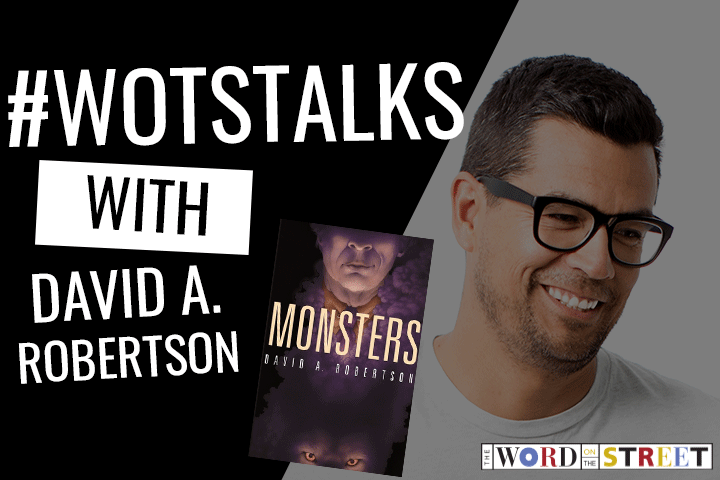
As always, The Word On The Street is coming up this September. But the fall can’t get here soon enough! So we sat down with David A. Robertson, author of Monsters, the second in his Reckoners series. Robertson will be joining us at the festival this year!
WOTS: The first book in The Reckoner series was your first young adult novel. What was the biggest difference in writing for this demographic? Was there one?
David A. Robertson: Yeah, there was definitely a difference. Strangers was the hardest book I’ve ever written, because writing YA was so hard. It wasn’t the complex plot or anything like that. It was figuring out how YA works. When I got it, I got it, but it took a lot of trial and error. I actually wrote Strangers three times.
So, I found the big differences were how action-oriented it had to be. I love these long, poetic passages when I write. I love exposition. And I love similes too. My editor gave me a one simile per chapter quota, that I mostly followed. Dialogue was big as well. A lot of dialogue. I got really good at it writing this book. It helped to read all the dialogue out loud, make sure each character talked differently, and every line of dialogue revealed character or advanced plot. By the time I started working on Monsters (book 2), I’d gotten the hang of it.
WOTS: Monsters is the second book in the The Reckoner series. How was writing the second book compared to writing the first? Are you expecting any challenges while writing the final book of the trilogy?
DAR: So, the second book was easier in one way. In the sense, as I said, that I knew how to write YA by the time I sat down and started working on Monsters. The challenges for it were different. I really wanted to defy convention, avoid sequelitis, I guess you could say.
I mean, the second book does expand the world, but it’s more about Cole and his mental health illness. So, it’s more intimate. I wanted to give readers less, when they might expect more, too. Less Choch, less Jayne, but making sure that when they do appear, they have impact. And I think it’s just really hard to write middle books in trilogies. There’s no beginning, there’s no end. So it’s asking a lot to write something compelling when you know there’s no payoff for the reader. And you have to give the reader something really good.
WOTS: The Reckoner series features traditional Indigenous spirit guides, like the trickster. Can you speak to how you explore writing traditional characters into the speculative fiction genre?
DAR: I’m not so sure that The Reckoner is speculative fiction. It’s more a supernatural murder mystery. But either way, authenticity, even within a fictional realm, was important. Making sure that I did the stories justice, and that I was reviewing these elements with the right people, to ensure that I’d done an appropriate and accurate job. It’s kind of a balancing act.
One thing I had to keep in mind, was that for some of these supernatural things, they aren’t legends. They are beliefs within the Cree culture that are held as fact. This comes more into play, certainly, with book 2, where the big bad of that story is grounded in Cree culture and history. The trickster spirit, for me, was important to at once do justice to, and also to offer a unique take on. Holding true but standing apart. But, as it turned out, Choch just went and did his own thing anyway. I wasn’t in control.
WOTS: What are your favourite places to write? Any quirky must-haves when it comes to sitting down and building out a story?
DAR: Oh yes. Big time. If you’re talking about literal places to write, like to engage in the act of writing. I am very picky. I need to write in the dark, typically. If I absolutely have to, I’ll write in light if I’m on a deadline and am pressed. But 90% of the time, I’m writing in the dark. I’m not sure why, it’s just how I write best.
The other thing is that I have to write with a good font, on a computer I’m comfortable with (the keyboard). Probably most important, I need to have good music. And I need to have lyrics with that music. For The Reckoner, I had certain artists I listened to a lot. Radiohead. Bon Iver. The National. Those were the bands I listened to on repeat.
In terms of place, I can write anywhere, as long as I have those things. Dark. Music. Font. Keyboard. Every writer has their quirks in this way, I think. Some writers might not touch a keyboard when it’s dark. They might need sun and a coffee and baroque music. We’re weird.
WOTS: Tell us a bit more about your process. How did you start writing? Do you have any favourite stories about when you were just starting out?
DAR: I first wanted to be a writer when I was in grade three. I’d written this book of poetry called The Bestest Poems I Ever Sawed. I wrote it, you guessed it, in the dark. I hid in the closet in my classroom, and banged out about 10 poems. My teacher made them into a book for me. That day, I ran home to my mom and cried out, “Mom I want to be a writer!” and ever since that day, that’s all I’ve ever wanted to be.
My process changes based on what I’m writing, so that’s hard to pin down. If we’re sticking to The Reckoner, what I did was write out a very detailed, long form synopsis. Like, 20 pages long maybe. And I outlined every single thing that happened, in sequence. When I sat down to write, I used that outline as a roadmap. This also helped me to maintain continuity.
The other thing I do is keeping to a quota. So, I’ll usually write about 1250-1500 words per day, when I’m working on a book. When I hit my quota, I stop until the next day. When I’m not writing, I consistently think about my next 1500 words.
WOTS: What would you say to a writer who’s just starting out? What one thing do you think it’s crucial to know?
DAR: Read a lot, and read with purpose. If you’re writing fantasy, read a lot of fantasy. Learn how the best writers do it, so that you can do your work better. And just write every day. Writing well is just like doing anything else well. You need to work really hard at it. I work my butt off, and I’ve done well because of that hard work. I don’t think there’s really a secret. I mean, yes, it helps to have some innate creative talent. But talent only gets you so far. So read, and write. All the time.
Want to keep up with the WOTS blog? Sign up for our newsletter here!

Get updated with every post. Subscribe to our RSS feed.

Read our most recent press releases to discover the latest festival news.

Have a question about The Word On The Street Toronto? Find your answer here.